Quick answer
To get a realistic sense of how long a subclass 186 visa application may take, check the processing-priority notice at the top of the Department of Home Affairs' Employer Nomination Scheme (subclass 186) visa page. For each priority group under Ministerial Direction 122, it shows the lodgement month the Department is currently processing. The global visa processing times tool gives one set of figures per stream and does not split them by priority. Neither is a decision date for your application, and the Department can update or change what it publishes without notice. This article is current as at 13 October 2026.
Why isn't the global processing time tool enough?
The global tool asks for a visa type, a stream and an application date, then returns a single pair of figures. On 13 October 2026, for the 186 Transition Pathway (see our guide to the Temporary Residence Transition stream), it showed 50% of applications processed in 21 months and 90% in 25 months. That is a very broad guide. It doesn't tell you which priority group an application falls into, and the tool itself points readers to the 186 page for the current assessment date of nomination and visa applications.

What are the processing priorities for the 186 visa?
The Department's skilled visa processing priorities page says visa applications for the 186 are processed under Ministerial Direction 122. It also says Directions 121 and 122 came into effect on 19 September 2026 and replaced all processing priorities under Direction 119. A ministerial direction, here one given under section 499 of the Migration Act 1958, tells the Department's decision-makers (delegates) the order in which to consider applications.
Section 6(3) of Direction 122 sets the order of priority, with paragraph (a) the highest and paragraph (d) the lowest (s 6(2)):
- "visa applications made by a primary applicant in relation to an occupation in construction, healthcare, teaching, agriculture, aquaculture, fishing and resources sectors, or an occupation related to Australia's law enforcement or defence interests" (s 6(3)(a))
- "all other visa applications where the applicant is a primary applicant who is in Australia at the time the application is made" (s 6(3)(b))
- "visa applications where the applicant is a primary applicant who is outside Australia at the time the application is made and whose application is not combined with another person's application at any time" (s 6(3)(c))
- "all other visa applications, except for those covered by subsection (4)" (s 6(3)(d))
Under s 6(4), "Visa applications that are combined with a primary applicant's application in a way permitted by the Regulations are given the same priority as the primary applicant's application under this section." Section 6(3)(a) does not refer to the applicant's location or to combined applications.
Section 5(2) defines the sector, law enforcement and defence occupations, so check your occupation against those definitions rather than assuming it is covered. For example, the law enforcement definition covers Police (ANZSCO Unit Group 4413) only where the applicant is nominated or sponsored by one of the police forces listed in the Direction. For how the tiers affect employers' and applicants' decisions, see our strategic take on Directions 121 and 122.
Does Direction 122 change who is eligible for a 186 visa?
No. Section 4(4) says the Direction does not change the skilled occupation lists, and applicants must still meet the requirements in the Act and the Regulations. The priority order affects the order of consideration only.
Does it apply to applications I lodged before 19 September 2026?
Yes. Section 3(3) says it applies to visa applications made, but not finally determined, before it commenced, as well as to applications made on or after commencement.
Can the Department depart from the priority order?
Yes, in limited cases. Section 7 allows a delegate to depart from the order if satisfied the application involves compelling circumstances affecting community safety, or the continuity of essential religious, cultural or community services in Australia.
What does the 186 page actually show?
As extracted by ALC on 13 October 2026, the notice listed these lodgement months:
| Priority group (Department's wording) | Currently processing applications lodged in |
|---|---|
| Construction, healthcare, teaching, agriculture, aquaculture, fishing and resources sectors, or Australia's law enforcement and defence interests | July 2025 |
| Visa applications from applicants who were in Australia when they lodged | March 2025 |
| Primary applicant outside Australia at lodgement and application not combined with another person's application at any time | July 2024 |
| All other visa applications from applicants who were outside Australia at lodgement | July 2024 |
On that date, the page showed the same lodgement month, July 2024, for the last two groups.
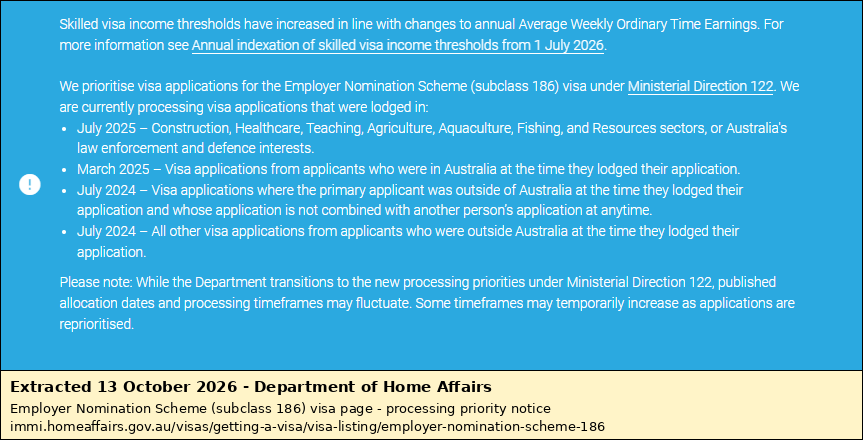
These dates were correct when we extracted them. The Department says published allocation dates and processing timeframes may fluctuate while it moves to the Direction 122 priorities, and some timeframes may temporarily increase as applications are reprioritised. They can be updated or changed without notice, so go to the live page for the current position.
How do I use the 186 page for my own application?
- Work out which priority group you are in, using your occupation and where the primary applicant was when the application was made.
- Compare your lodgement month with the month shown for that group on the 186 page.
- Check which stream of the 186 visa you are in, because the global tool is split by stream, and check the live page again before relying on it.
In our view, an application lodged earlier than the date shown for its group is within the range the Department is currently working through. That is our reading of the page, not a prediction. Applications can take longer, for example if information is missing, and a published date is not a commitment to decide by any day.
FAQ
Will my priority group guarantee a decision date?
No. The page shows the lodgement month the Department is currently processing, not a deadline for your application.
If I am applying from outside Australia, am I always in the lowest priority?
No. Tier 1 (s 6(3)(a)) does not refer to the applicant's location, and tier 3 (s 6(3)(c)) covers a primary applicant outside Australia whose application "is not combined with another person's application at any time". All other visa applications, except those covered by s 6(4), are in tier 4 (s 6(3)(d)).
Does this article cover how 186 nominations are ordered?
No. Direction 122 applies to visa applications (s 3(1)), and ALC has not verified how nominations are ordered.
New to the 186? Start with What is the 186 visa in Australia?
Sources
- Direction 122 (Home Affairs), read in the signed copy supplied to ALC
- Skilled visa processing priorities (Home Affairs, last updated 7 October 2026)
- Employer Nomination Scheme (subclass 186) visa (Home Affairs), extracted 13 October 2026
- Global visa processing times (Home Affairs), extracted 13 October 2026
About the author
Ruobing Yang, Legal Practitioner Director
Legal Practitioner Number (LPN): 5511418
Profile: alclawyers.com.au/person/ruobing-yang
LinkedIn: linkedin.com/in/ruobingyang209
Published 13 October 2026. Last reviewed 13 October 2026.
This article is general information only and is not legal advice. Processing priorities and published dates can be updated or changed without notice. For advice on your circumstances, contact ALC Lawyers.